
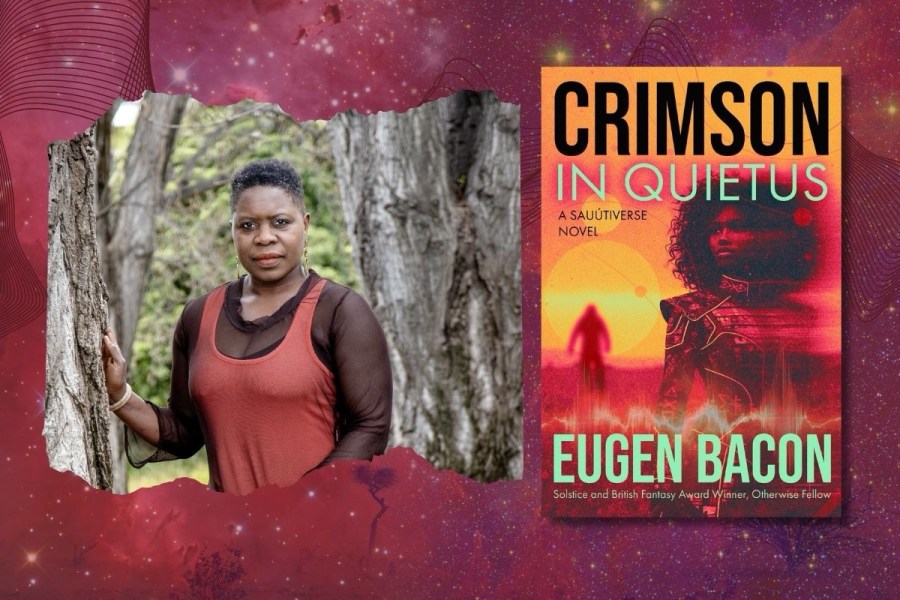
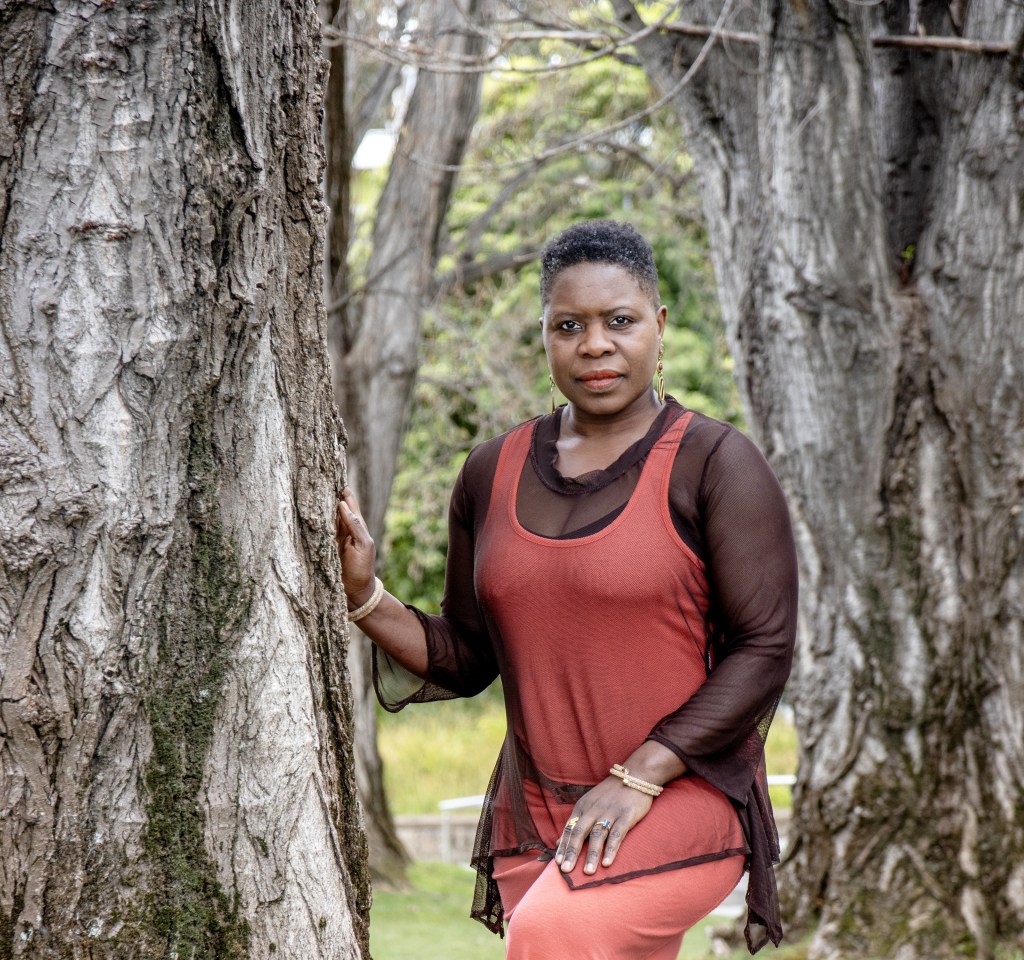
For this installment of “Beneath the Macabre”, we have an incredible author by way of Australia, Eugen Bacon. The African-Australian writer who is hailed as the “queen of genre-bending speculative fiction” (she certainly has my vote) has won multiple awards such as the Solstice, British Fantasy and Foreword Indies Award as well as being a twice World Fantasy and Shirley Jackson Award finalist, a finalist in the Philip K. Dick Award, Ignyte and the Nommo Awards for speculative fiction by Africans. With her latest work, “Crimson in Quietus”, she leans even further into the melding of science-fiction and fantasy with mystery and some horror elements weaved into the story. I am pleased as punch that I get to peek around in her mind as we go Beneath the Macabre.
“Stealing sound” is such a creepy yet cool premise. It’s certainly something I’ve not read before. Where did that idea come from, and how did you work out the rules for how it works in the world you’ve created?
Crimson in Quietus is set in an Afrocentric universe named the Sauútiverse, a shared world in which a collective of like-minded authors from the African grassroots created a unique collaborative world rooted in sound magic. As we brainstormed what different planets might look like, we deeply explored the nature and power of sound. We focused on the spoken word and chant and—even curiously—we interrogated the dread or anomaly of silence. In a world where sound is everything, its absence hinders magic and sound-based technology. As a collective, we also explored pools of silence—spaces of reflection, rehabilitation, even meditation, but also anomalous pockets created in dark magic. This stirred me to consider the inherent power one might have if they could steal sound from others.
Sauútiverse, maadiregi, Mahadum–your invented vocabulary is so unique and special. Did any of it get renamed a dozen times before it stuck?
“Maadiregi” is a title that exists across stories in the Sauútiverse. It’s a title given to someone who uses knowledge of the high language, sound magic, or technology professionally—including scholars (who contribute to knowledge in the “mahadum”) and the skilled (like engineers, technicians, and architects). We also created the term “uroh-ogi”, for instance—these are professional healers of people and animals.
To sum up, I relished the privilege of leveraging the inherent worldbuilding in the Sauútiverse and sub-creating within it—how awesome is that?
This book straddles horror, mystery, and academic intrigue. What’s the scariest scene you wrote, and did it get under your own skin a little?
The killing fields were definitely unsettling to write; say the shifting taste and aroma of soul sound from the dying:
His fingers are enough. They press against her skin, feel where to cut. Here. His fingers and a blade are enough. She’s unaware and, if she woke now, she wouldn’t remember. He doesn’t raise his head or turn. It doesn’t matter what he knows, how he knows, because he feels the shape of destiny. It smells like oranges. And he wants to eat.
Your killer understands sound as intimately as Muso’mi does. Was writing a villain who mirrors your hero that closely fun, unsettling, or both?
I’d say both! Reflecting upon pools of silence—the depths and manners of silence—guided me toward its manifestation through hindrance or absorption, channeling a protagonist towards “good” or “evil.”
Did any aspect of your real life come into play in this universe that was unexpected for you, or did you make it a point never to let reality touch the worlds you create?
I am an immersive writer, and I feel deeply. I find affinity with my characters, feel their longings and regrets, their passions and aches. Motherhood, connection, belonging/unbelonging… these are all lived experiences. So, yes, reality almost always touches the worlds I create.
Which would you prefer as a writer: building a brand-new universe from scratch versus writing in an established world?
In a way, writing in an established world is both easy and hard. Easy because the muse is already there—you have a skeleton to work with. But it’s also very hard—you are worried about rejection or misrepresenting. Before Crimson in Quietus, I’d written other stories and a novella set in the Sauútiverse. Yet this was the scariest novel I’ve ever written.
The truth is, I don’t know which I prefer—a brand-new universe of my own, or a shared universe. It depends on the story that wants to come out.
For the horror readers who haven’t gotten a chance to experience your books yet, give us one sentence that sums up this book.
I think PK Dick Award finalist Tara Campbell says it best:
“Bacon balances dashes of wit with visceral horror as her dynamic female heroines battle an unspeakable evil in a world where the study of science blends seamlessly with fantasy and magic.”
It truly was a pleasure to get to interview Eugen Bacon, and her latest novel “Crimson in Quietus” is available at Meerkat Press, Amazon, and Bookshop.org, so don’t be shy! A big thank you again to Meerkat Press for letting The S Reaction participate in their Blog Tour.
 The S Reaction