
When your last heist leads you on a journey that involves a deep, introspective look at yourself and your actions, just know you’ve made a wrong turn somewhere. And no, you can’t reverse the car. You can only go forward, even if it takes you through some interesting turns and forks in the road.
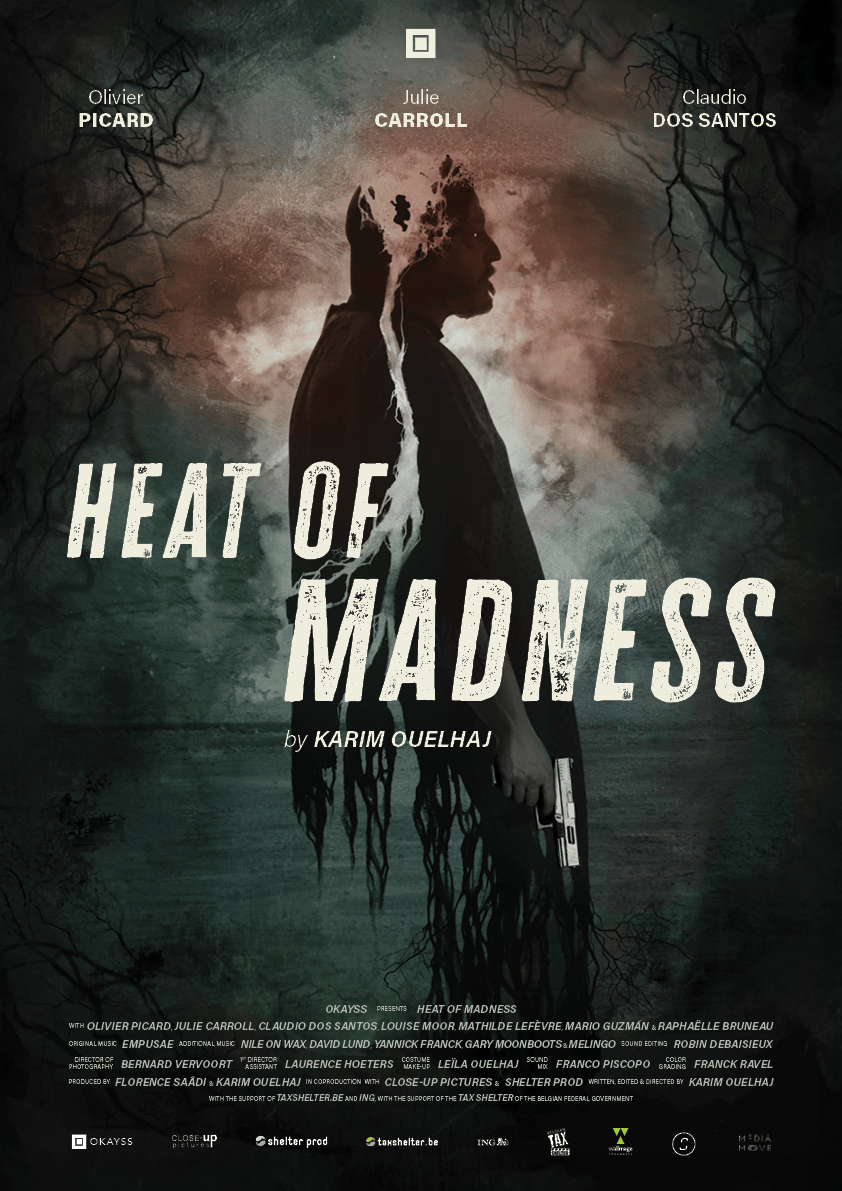
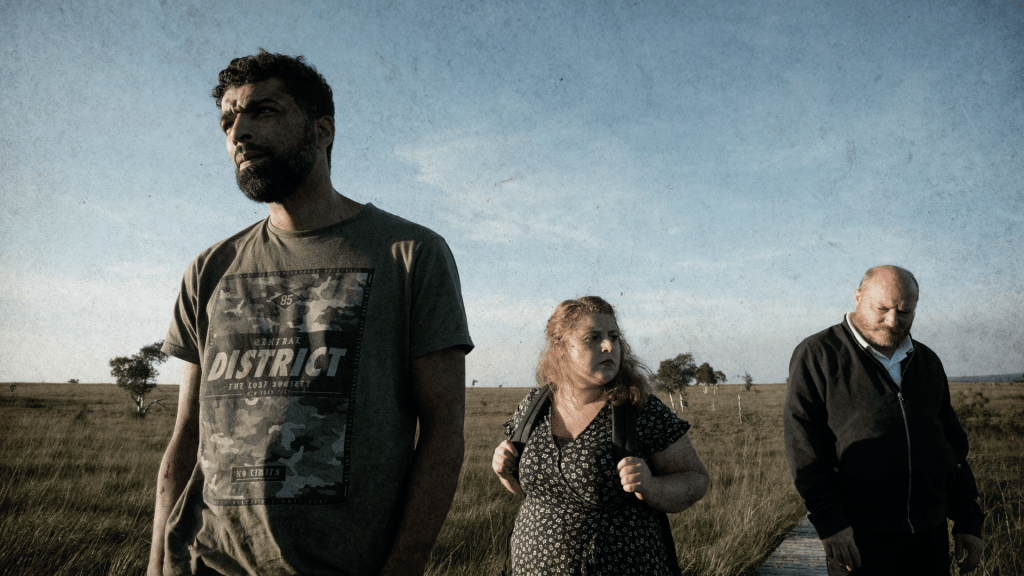
That’s what Karim Ouelhaj’s dark psychological thriller/supernatural horror ‘Heat of Madness’ does for our main character, Scola, played by Olivier Picard. The film opens with what looks to be a forest that will play a role throughout the film. Scola is there but covered in mud, crawling through it while onlookers watch with blank stares. One individual adorned in a golden headpiece looks on as well, but you can tell they are the one who will ultimately judge Scola. The next scene shows Scola dressed in his best with a suitcase in hand, going through security. Once he’s cleared, he looks at himself in a mirror in a bathroom, readying himself for what’s next. He is then handcuffed to the briefcase and makes his way to a waiting group of folks. We abruptly cut to the next scene, seeing a man we will know as Scola’s partner who is having a time in what looks to be a club of naughtiness. When he arrives home, he is met with questions- questions he never answers from a wife who worries, and rightfully so.
Scola is with his wife, who is very pregnant and only wishes for him to stick around, as she’s alone so often, to which Scola responds with his idea to do a last heist to set them up for the future. It is clear that Scola is not a gentle or loving husband, nearly becoming physical with his wife a few times in their interaction. Scola is not a “complicated” man; he’s a man who is volatile and comes off as a jerk on many occasions throughout this film. He is hard to root for, and I believe that’s the point. We’re not supposed to empathize with him or think of him as a “good man”. This is intentional. We especially see the worst of him once he finds out that the objects of the heist that were supposed to set them up are no longer around. The diamonds are missing, and he has to get them back or else.
Scola goes on a journey to recover the diamonds, but while on this goose chase, he discovers that his accomplices are the ones who are the reason for the diamonds having gone missing. One by one, he finds them and seeks answers until he comes across a young woman called Petite Pomme. She is quiet at first, but opens up along the way while also having the ability to leave…little gifts…that she poops out. I know it sounds looney, but she is not what she seems, so her “sharting” out little apples is fitting. Trust me and this process!
Speaking of “process”, Scola starts to have images that flash back and forth between the present and what looks to be another time in the not-so-distant future. Or it could possibly be his actual reality. It is hard to tell, as these moments are woven into the film over the course of the story. Scenes in the forest, people looking at Scola as they’re watching him, in one scene calling for him to “go away” and calling him “the devil”. Other scenes of Scola in a hospital that is run-down, rooms filled with disturbing, blood-soaked acts. It feels as if he’s in and out of reality and consciousness. Or possibly in a hell of his own making, answering for the things he’s done. Until we get a scene where he is meeting with doctors who give him a diagnosis that might make sense, given that we’re witnessing a man do some horrific things in the name of exacting revenge for a betrayal. But by the end of the film, we get to see Scola come to the truth of things, sitting in front of someone who helps him confront the reality of his actions and how they affected not just himself but those around him, especially his wife.
‘Heat of Madness’ made me curious and question whether Scola was experiencing atonement for his wrongdoings before death took him because he was already dead, or if, for him to continue on in life, he needed to face and accept what he had done. With the writer and director Ouelhaj being inspired by Dante’s Purgatorio, he created a film that examines the human soul, the heart of someone, and the human psyche. The sharp images displayed throughout the film felt surreal and jarring at times, but still fed my curiosity. I know Scola was not meant to be someone we looked at as a hero with a hero’s arc; this was made very clear, as there didn’t seem to be a redemption song at the end for him. He was a man who was flawed, who made grave decisions, and seemingly paid for it one way or another.
Ouelhaj’s ‘Heat of Madness ‘, which premiered at the 2026 Sitges Film Festival, is a thriller that was an interesting watch for me, and his films aren’t meant to be easy; they’re purposeful and meant to challenge us as the viewers. His previous film, ‘Megalomanic’, did the same, leaving audiences in awe. But this go ’round, he is really leaving the audience something to sit with. So if you enjoy stories with depth but also some great and creative shots, then ‘Heat of Madness’ will be one to watch.

